Faceroom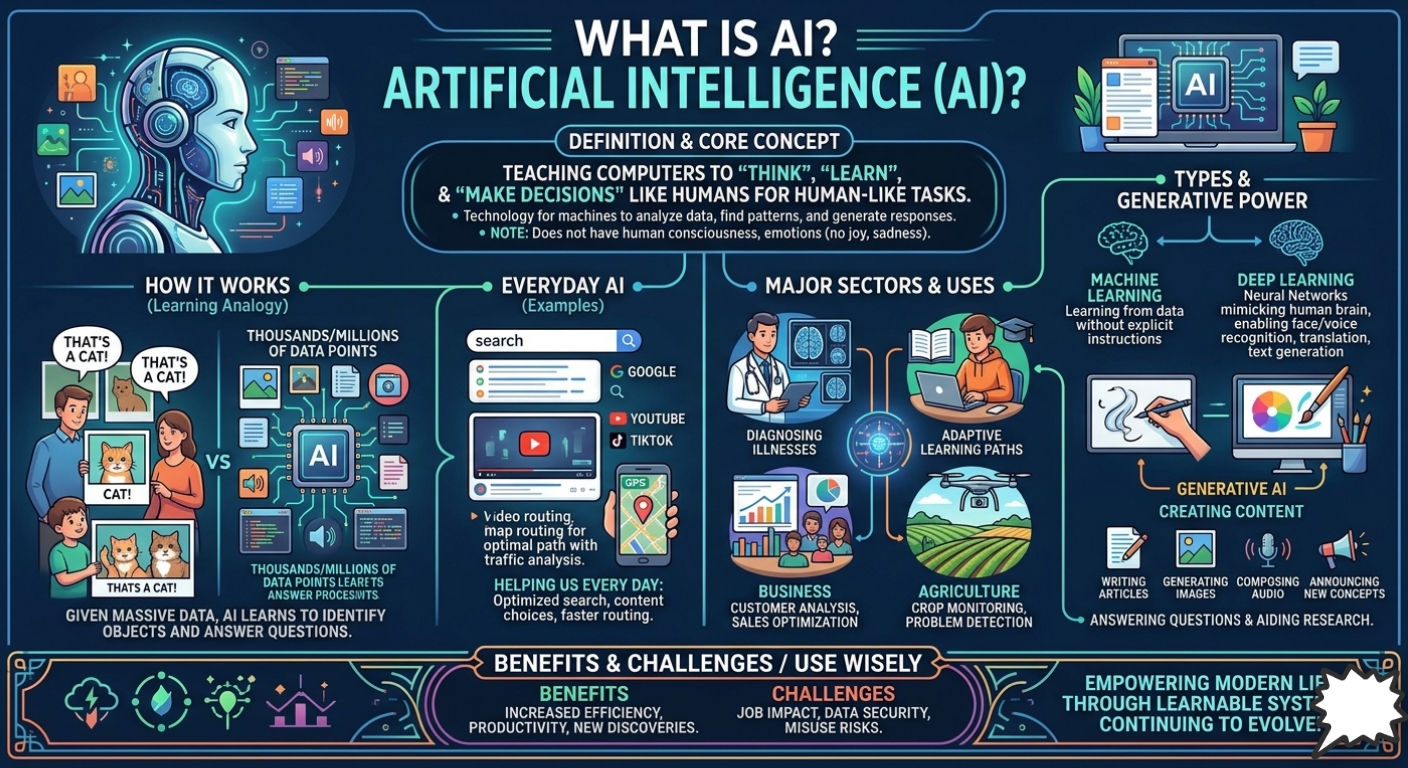
AI, or Artificial Intelligence, is a technology that enables machines and computer programs to perform tasks that typically require human intelligence. Put simply, AI is a human effort to teach computers and machines to “think,” “learn,” “analyze,” and “make decisions” as much as possible, just like humans do.
This does not mean that AI has a mind or emotions like a human. It does not feel joy, sadness, anger, or love. Instead, it can analyze massive amounts of information, recognize patterns within it, and generate responses based on that data and the training it has received.
To better understand AI, one can look at how a child learns. When parents repeatedly show a cat to a child and say “that’s a cat,” the child learns to recognize a cat when they see it again. AI works the same way. It is fed thousands or millions of data points, and it learns to identify things and answer questions based on that data.
Today, AI is already a part of everyday life. When someone uses a search engine like Google, it utilizes AI to find the results that best match their search. When you watch videos on YouTube or TikTok and new videos are recommended based on your preferences, AI is helping to select them. When you use GPS or maps on your phone to find the fastest route, AI is also assisting by analyzing traffic and available paths.
AI can operate in many different fields. In healthcare, for example, it helps doctors diagnose illnesses by analyzing medical images and test results. In education, it can help students receive explanations and training tailored to their needs. In business, it helps analyze customer behavior and optimize sales. In agriculture, it can assist in monitoring crops and identifying potential problems.
There are several types of AI. One of the most widely used is Machine Learning, which is a method of teaching computers to learn from data rather than giving them detailed instructions for every scenario. There is also Deep Learning, which is a more advanced form of Machine Learning that mimics the way the human brain works through structures called “neural networks.” These technologies enable AI to recognize faces in photos, understand speech, translate languages, and generate text.
Among the major advancements in AI is its ability to generate new content. It can write articles, create images, compose audio, and sometimes even generate videos. For example, some AIs can design logos, posters, or artwork based on user prompts. Others can answer questions and assist with learning and research.
While AI brings many benefits, it also presents challenges. It could impact certain jobs because some tasks can now be completed by machines faster than by humans. There are also concerns regarding data security and the potential for misuse. Therefore, it is necessary to use it carefully and wisely.
Overall, AI can be described as one of the most important technologies of today’s digital era. It is a computer system designed to learn, analyze, and assist in carrying out tasks that traditionally require human intelligence. It is already being used in numerous fields, and its role in life and work is expected to grow and evolve even further in the coming years.
About the Author